Posts tagged ‘environment’
The fungus that wiped out 3.5 billion chestnut trees in the USA has been found for the first time in Britain. Chestnut blight, caused by the fungus Cryphonectria parasitica (C. parasitica), has been confirmed by Forest Research scientists on trees in two small orchards of European sweet chestnut (Castanea sativa). The trees were imported by an English tree nursery from the same grower in France. The sites in Warwickshire and East Sussex are the first findings in Britain. Until now, the English Channel had prevented its spread from mainland Europe.
The fungus infection is usually fatal to European sweet chestnut and its North American relative, Castanea dentata, although it appears to be less virulent in Europe than it is in America. It is believed to have first originated in Eastern Asia before being introduced to North America in the late 19th Century, where it has since devastated billions of trees in the East of the country (see The American Chestnut Foundation). It was first identified in Europe in 1938, in Italy, and has since spread to most parts of southern Europe where sweet chestnut is grown, and to parts of northern Europe.
Identifying chestnut blight
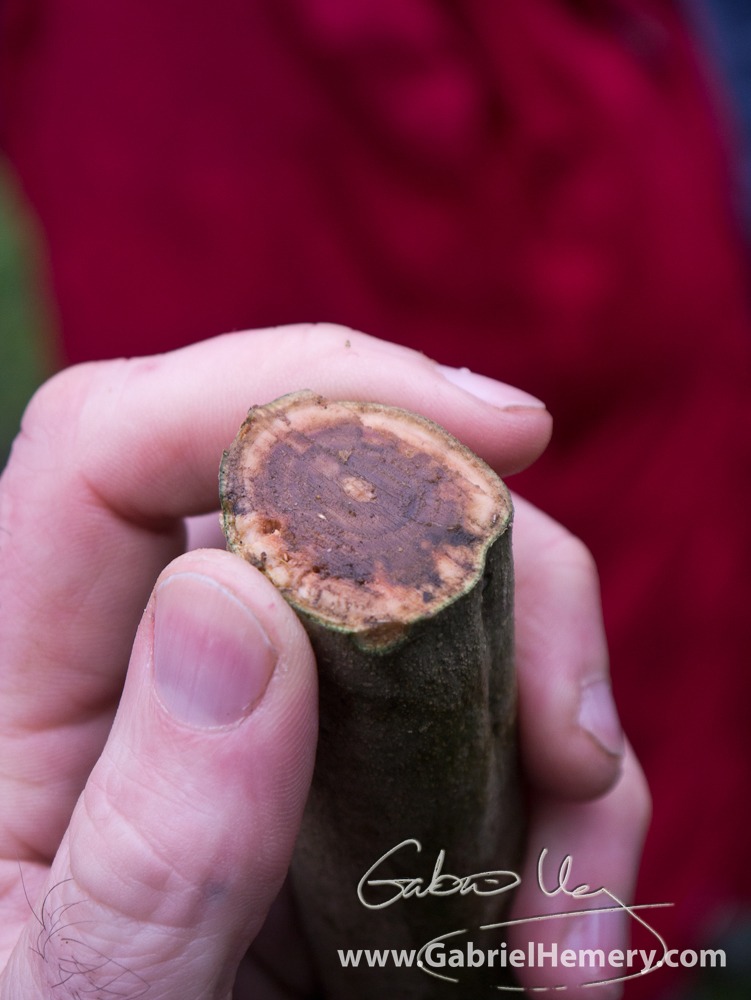
The most obvious symptoms of chestnut blight are wilting and die-back of tree shoots. Young trees with this infection normally die back to the root collar, and might re-sprout before becoming re-infected. Other symptoms, such as stem cankers and the presence of fruiting bodies can also occur.
What now?
The trees where the fungus were discovered had been imported into the UK for nut production. As I have written before (e.g. Climate Change and Global Trade), the import/export of trees is potentially the most significant factor in the spread of new tree pests and diseases. Case proven I think. Let’s hope that FERA (Food & Environment Research Agency of the UK Government) is given adequate resources to tackle this very serious fungus. Afterall, sweet chestnut is a beautiful tree species in our forests and when coppiced, as it is in commonly in Kent (see Sweet Chestnut Coppice), it is one of the few forest systems that pays well and regularly.
Gabriel Hemery
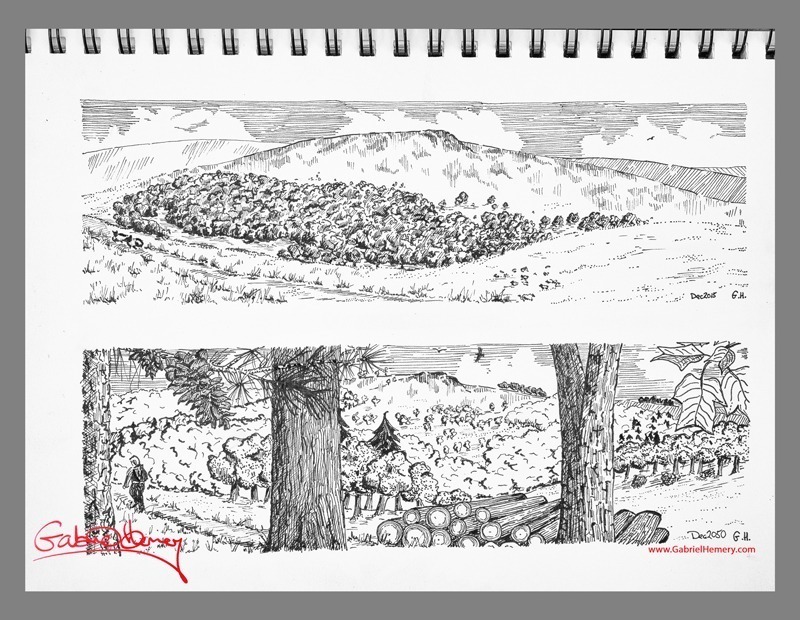
Where we could be – with vision, national effort and political support
England’s woods and forests are embraced as vital to the health, wealth and well-being of the Nation and its people – recognised as having a key role in curbing climate change and enabling human society and wildlife to contend with its impacts. The more frequent and violent cycles of drought and downpour predicted by climate scientists at the end of the last century are now a reality. Our woods and forests are classed as a national network of strategic natural defences.
Following the country-wide outcry against its plans to dispose of England’s public woods and forests, the Coalition Government of 2011 changed tack, turning public brick-bats to bouquets by granting the Public Forest Estate (PFE) full and lasting protection. It received international acclaim following the UN International Year of the Forest with a commitment to restore England’s tree-cover over the next 50 years back to what it was at the time of the Domesday Book in 1086 – around 15% of our total land area.
This effort proved to be all the more urgently needed following the near decimation of our native oaks by a series of invasive diseases, benefiting from England’s warmer, wetter climate. Spending on research into pests and diseases was substantially increased, with strong public support.[1]
Unable to refute the hard evidence of the economic, environmental and social benefits delivered by well-managed woodland, the Treasury approved a long-term budget line for this visionary initiative – unleashing a collective effort from local communities, councils, businesses, private landowners, conservation groups and public bodies across the country. By 2050, over half a million hectares of new planting has been achieved – England’s 21st Century ‘Domesday Forest’ is on-target. As well as helping the country withstand and adapt to the impacts of accelerating climate change, new woods and forests are making communities across England better places to live, pulling in investment and creating thousands of new jobs.
An equal effort has been directed at bringing long-neglected woodland into positive management. Tens of thousands of privately-owned and community-run woods hum with activity – delivering valuable harvests of timber and fuel for heating homes in addition to providing vital ‘social services’ of carbon-storage, flood protection and a thriving network of wildlife habitats.
By 2050, England’s precious heathland habitats have been cleared of inappropriate plantations and returned to their former purple glory. Our remnant ancient woodlands long overdue protection as ‘the jewels in our woodland crown’, form the cornerstones of the Domesday Forest – all those damaged by coniferisation are now under restoration.
Forty years back, foresters and those seeking to make a living from woodland were an endangered species. In 2012, England’s woods and forests supported just over 100,000 jobs [2]; in 2050, there are double that number, requiring people with a wider range of skills to maximise the many and diverse benefits that well-managed woods provide. Jobs for young people – a key concern in 2012 – have been boosted by the much sought-after National Forestry Apprenticeship Scheme.
As thousands of long-neglected, shaded-out woods have been brought back into active management, so the numbers and variety of woodland wildlife have burgeoned. With sunlight once again reaching the under-storey, dormant seed-banks have sprung to life – bluebells and other woodland plants carpet the forest floor. The decline of woodland birds has been reversed – the nightingale’s liquid song is no longer confined to poet’s verses.
For all the efforts by individuals, communities, private woodland owners and commercial foresters, this vision could not have been realised without the leadership and strategic oversight of Forests for England – the publicly accountable successor to the Forestry Commission. Forests for England (FfE) is tasked with sustaining the character and diversity of England’s existing and future woodland, while ensuring the long-term commercial viability of our woods and forests. Its advisory and research role is underpinned by decades of practical experience on what is still known as the Public Forest Estate (PFE).
To those familiar with the jargon, what FfE does is ‘integrated land use’. To the rest of us, that means making sure our woods and forests offer they best they can, hectare for hectare, for the good of all – producing valuable timber and fuel, providing access and recreation for people, protecting homes and businesses from flooding, and helping our wildlife to hold on during this period of rapid change through a network of linked habitats.
In 2011, politicians questioned whether the country could afford to care for our woods and forests. In 2050, woods and forests are central drivers of a booming low-carbon economy. Vibrant markets exist for timber, woodfuel and carbon-capture. No urban development is conceivable or permitted without an equivalent investment in green infrastructure – trees, woods and forests are as integral to our urban quality of life as energy, water and sewerage systems.
Something else. Beyond their obvious strategic and economic value, the effort to renew England’s woods and forests has drawn people together, creating a sense of community, place, well-being, and that most elusive of cultural concepts, national identity – which like our woods and forests, seemed under threat in 2011.
Reproduced from Our Forests – a vision for England’s woods and forests
References
1 UK government launches tree biosecurity plan
2 Figures for 2008 taken from the Annual Business Inquiry 2009 and Office for National Statistics regional gVA December 2009 published by the Office of National Statistics.
Biochar was one of those terms that when first heard left me none-the-wiser. You mean it’s charcoal but with a different name – why’s that? You bury it – that seems a waste, why not burn it? In case it’s a new term to you, here’s a brief overview of biochar.
Biochar – what is it?
Biochar is a plant-based product, generated by heating biomass in the absence of oxygen. It can be made from wood, in which case it is no different in from charcoal, except that producers say the manufacturing process is more efficient and greener with the modern equipment used for biochar production than old-fashioned charcoal kilns. It also differs from charcoal in that it can be made from other plant material including straw, grain, stalks and roots. It is normally of fine size, for example tiny fragments or even dust.
How is biochar made?
By burning in a kiln without oxygen and at very high temperatures, typically over 350°C, the plant cells breakdown with the cellulose and lignin forming amorphous carbon (biochar), CO2, water and some other volatiles. The technical term for this process is pyrolysis.
Biochar – what’s the big idea?
Biochar first surfaced when Peter Read, a research fellow at Massey University in New Zealand, coined the term in 2005 to describe finely divided pyrolysed biomass material prepared specifically for soil improvement. Biochar can improve soil fertility, structure, acidity and water quality, while also reducing the need for fertilisers and watering. Biochar is not a new idea but one based on a technique used by Amazonian Indians to improve soil conditions, where it is called Terra preta.
What really excited environmentalists was the idea that biochar can sequester carbon (capture it). Instead of burning organic material (as in the traditional use for charcoal), if biochar is buried instead then the carbon ‘locked’ in it will be permanently removed from the atmosphere. Therefore, using biochar could in theory help us lower our carbon emissions and prevent climate warming.
Biochar – debate and contention
Biochar has attracted much heated debate. Among its supporters is James Lovelock, the founder of the Gaia hypothesis, while against has been Biofuelwatch, the Organic Consumers Association, and the Rainforest Action Network. One of the most interesting discussions was initiated by a damning article by environmental commentator George Monbiot in UK newspaper The Guardian in 2009. In the defence of biochar, both originator Peter Read and James Lovelock, responded in what turned out to be a fascinating debate.
- Original article by George Monbiot: Tuesday 24th March, 2009
- Response by James Lovelock: 24th March 2009
- Response by Peter Read: 27th March, 2009
“This gift of nature is the best way to save us from climate catastrophe. Biochar schemes would remove carbon from the atmosphere and increase food supply.” Peter Read
“There is an outside chance that one procedure could really turn back the clock on Global warming and that is burying carbon. All you have to do is get every farmer everywhere to make a profit by turning all his agricultural waste into char and burying it. “James Lovelock
Gabriel Hemery
Further reading
- The Biochar Debate: Charcoal’s Potential to Reverse Climate Change and Build Soil Fertility
By James Bruges. 120 pp. Chelsea Green Publishing. (2010) - Oxford Biochar
- Biochar Innovation
I came across a clever new web search tool recently that aims to help sustain the Earth’s rainforests by collecting money through internet searches.
Ecosia refer to themselves as a “social business”, and technically to their web search as a “search engine mask” as it is powered by Bing and Yahoo. Apparently the business was able to donate 125,000 Euros (164,000 USD) in its first operating year (to December 2010), for its rainforest protection program run jointly with the WWF.
I’ve added a permanent link in the column of my blog pages. Perhaps we can help a little from this website in future.
Gabriel Hemery


Environmental consciousness awakens
GalleryI wrote a year ago about Environmental Consciousness, when I created this image to encourage reflection of our collective responsibility towards the future of mother Earth.
The landmark United Nations climate conference at Durban that ended December 9th 2011, reached consensus to start negotiations on a new accord that would place all countries under the same legal regime enforcing commitments to control greenhouse gases by 2020. In other words, the people on Earth are beginning to act responsibly although progress compared to targets discussed in conferences a decade ago are still to be achieved. It is early days, hence my use of the words ‘awakens’. Governments have heralded the conference as a major breakthrough but campaigners believe that our ‘climate debt’ continues to deepen with the world’s poorest countries faring worst.
Gabriel Hemery
United Nations Framework Convention on Climate Change
COP17 – saving tomorrow today
Share this:
Like this:
1 Comment